
TL;DR
AI dating photos work best when they look current, natural, and consistent with real life. The safest approach is to generate several realistic options, avoid misleading edits, and choose images that show face clarity, lifestyle context, and trust.
A strong dating app photo has to do two jobs at once: earn attention quickly and still feel real after a match. An AI profile picture generator for dating apps helps create polished dating images from existing selfies or prompts, but the best results in 2026 favor authenticity over glamour. AI profile picture generator for dating apps: a tool that uses artificial intelligence to create or improve profile photos for platforms such as Tinder, Bumble, Hinge, and other social or dating profiles. Looktara supports this broader visual-branding need across profile, social, and creator use cases, including people who want cleaner personal imagery without booking a full photo shoot.
Table of Contents
What is an AI profile picture generator for dating apps?
An ai profile picture generator for dating apps is software that creates, edits, or upgrades dating profile photos using artificial intelligence, usually from uploaded selfies, text prompts, or both. The goal is not to invent a different person, but to produce clear, attractive, believable images that match how someone actually looks.
In practical terms, these tools sit between a selfie editor and a professional photographer. Competitor pages in the current search results emphasize Tinder, Bumble, and Hinge, with some services offering packs of AI dating photos, multiple outfits, and lifestyle scenes.
Dating avatar: a profile image that represents a person online. Wikipedia describes an avatar in computing as a graphical representation of a user or persona, which fits dating photos when the image acts as a first impression.
The strongest dating profile photo is not the most perfect image; it is the image that looks appealing, recent, and easy to trust.
AI image generation also belongs to the wider field of digital art. Wikipedia defines digital art as artistic work that uses digital technology as part of the creative or presentation process. Dating photos are more practical than artistic, but the same image-generation techniques can apply.
Research by Nantheera Anantrasirichai and David Bull in Artificial Intelligence Review examined AI in creative industries, which helps explain why profile-image tools have moved from novelty apps to everyday creative software.
Which dating profile photo styles work best in 2026?
The best dating profile photo styles in 2026 look natural, current, and socially credible, with clear face visibility and realistic lifestyle context. Images that appear overly staged, heavily filtered, or inconsistent across a profile can reduce trust, even when the photo looks attractive in isolation.
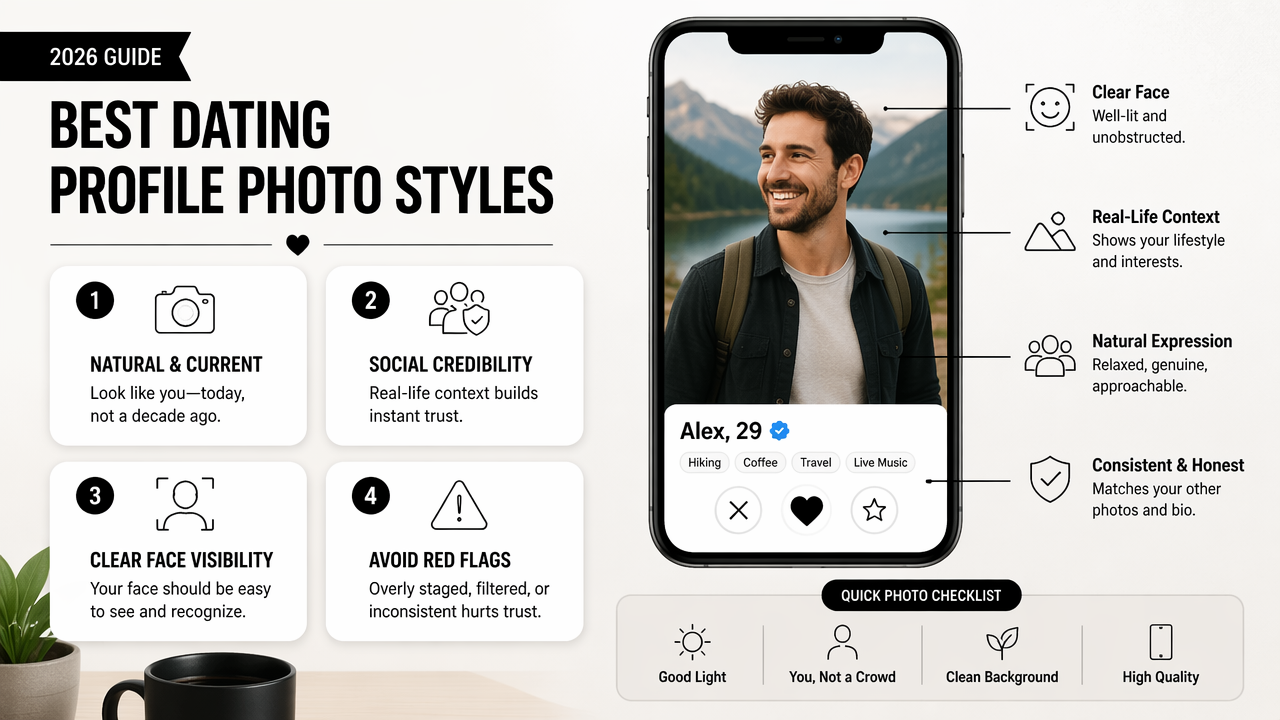
A practical dating set should include several roles rather than five versions of the same portrait:
- Primary headshot: clear face, relaxed expression, clean background.
- Lifestyle image: casual setting such as coffee, outdoors, travel, or a hobby.
- Full-body photo: accurate proportions and everyday clothing.
- Social-context photo: one image that suggests real life, without confusing group framing.
- Personality image: pet, sport, creative activity, or personal style detail.
For people who also need professional images, a dating photo set can share visual DNA with a cleaner career image. A resource such as Looktara's resume headshot AI generator shows how lighting, face clarity, and controlled backgrounds can support credibility across LinkedIn, portfolios, and dating apps.
Dating photo style comparison
| Photo style | Best use | Risk if overdone | Better AI prompt direction |
|---|---|---|---|
| Clean headshot | First photo on Hinge or Bumble | Looks like a corporate ID | Natural window light, relaxed smile, casual outfit |
| Outdoor lifestyle | Shows energy and approachability | Fake travel-blog look | Realistic park, city walk, weekend clothing |
| Cafe or bar scene | Adds warmth and social context | Too staged or model-like | Candid seated portrait, soft background blur |
| Fitness photo | Shows discipline and lifestyle | Can feel performative | Post-workout casual portrait, not mirror selfie |
| Studio glamour | High visual impact | May look artificial | Minimal retouching, realistic skin texture |
The table shows the main tradeoff: AI can improve presentation, but dating apps reward believability. A perfect-looking image that feels synthetic can work against the profile.
People building a creator or side-business presence may also reuse a compatible visual style on social channels. For example, a polished dating headshot can sit near brand content such as an Instagram profile picture AI generator without feeling disconnected.
How should AI dating photos be created safely and authentically?
AI dating photos should be created by starting with accurate source images, choosing realistic scenes, avoiding identity changes, and checking every result for misleading details. Safe use means the final image still represents the person someone would meet offline.
Deepfake risk matters here. Wikipedia describes deepfakes as images, videos, or audio edited or generated with artificial intelligence or audio-video tools, depicting real or fictional people. Dating photos should avoid that territory by keeping identity, age, body type, and facial structure honest.
Authentic AI dating photo workflow
- Start with recent selfies. Use clear, well-lit photos that show the current face, hair, and style.
- Pick realistic scenes. Choose places that match actual life, not fantasy vacations or luxury settings.
- Limit face changes. Keep skin texture, facial shape, and distinctive features intact.
- Generate variety. Create headshot, lifestyle, and full-body options rather than one visual theme.
- Reject artifacts. Remove images with odd hands, warped jewelry, strange teeth, or mismatched eyes.
- Test for consistency. Make sure the profile looks like one real person across all photos.
Human-centered AI research is useful for this topic because dating images affect trust and social interaction. Özlem Özmen Garibay and coauthors outlined human-centered AI challenges, a frame that fits personal-image tools where agency, fairness, and user control matter.
Common mistakes include using photos that make someone look much younger, changing body proportions, adding fake wealth signals, or producing images that resemble influencer ads. Those choices may increase curiosity, but they can also create disappointment when the profile moves from chat to real life.
A good AI dating photo edits the presentation, not the person.
There is also a sustainability angle as AI image creation depends on cloud computing. A 2022 survey by Avita Katal, Susheela Dahiya, and Tanupriya Choudhury reviewed energy efficiency in cloud computing data centers, a reminder that repeated generation has infrastructure costs even when each image feels instant.
How does Looktara fit into a dating photo workflow?
Looktara fits a dating photo workflow by helping create polished, platform-ready personal visuals that can also support professional, creator, and social profiles. The Looktara platform is especially useful when a person needs a consistent image system, not just one dating app photo.
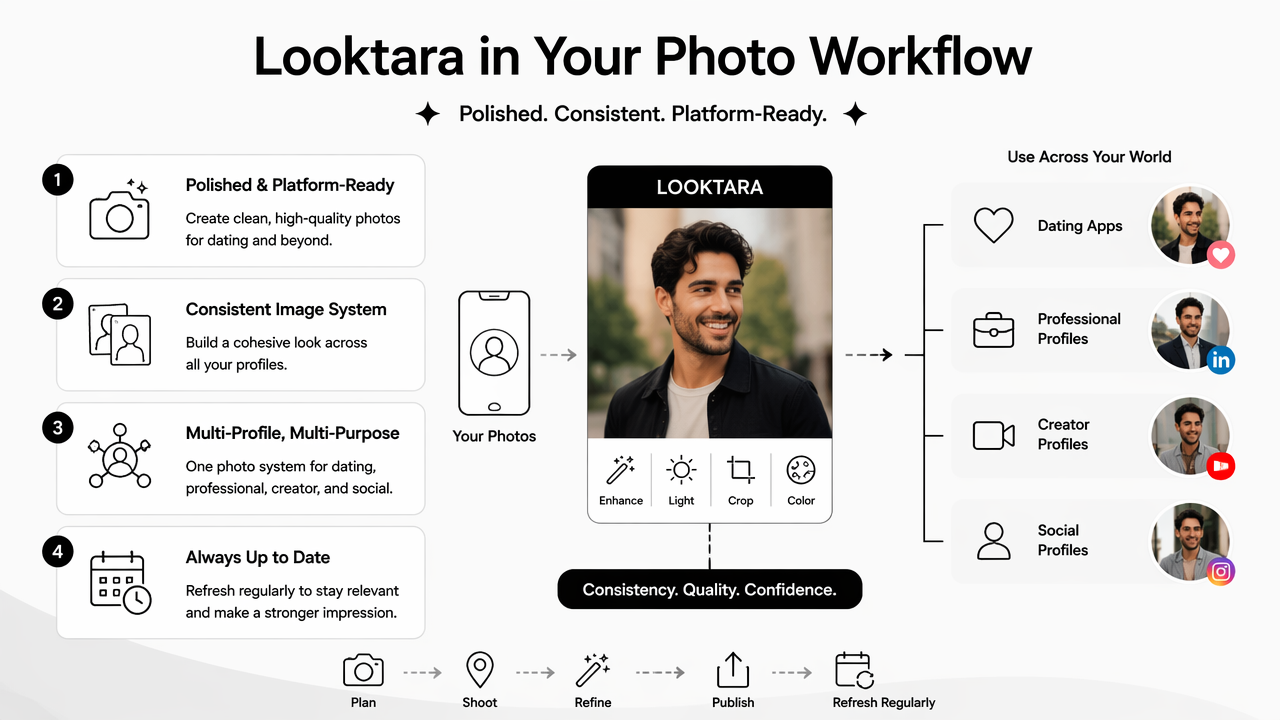
Many dating-app users now maintain a broader public presence. A freelancer may need LinkedIn credibility, a founder may need a warm personal brand, and a creator may need profile images that carry across Instagram, TikTok, and short-form video. In that setting, dating photos should not feel disconnected from the rest of the person's online identity.
Where each image belongs
| Use case | Image goal | Helpful Looktara-related asset |
|---|---|---|
| Dating app primary photo | Warmth, face clarity, trust | Natural profile-style portrait |
| LinkedIn or portfolio | Competence, polish, reliability | Professional headshot style |
| Instagram profile | Recognizable personal brand | Instagram icon AI generator |
| TikTok or Reels cover | Fast visual recognition | TikTok cover AI generator |
| Personal website | Strong first impression | Website hero AI generator |
The best workflow starts with the dating profile goal, then expands outward. A primary dating photo can be friendly and casual, while a professional image can be sharper and more structured. Both should still look like the same person.
With Looktara, the practical advantage is consistency. A profile image, website hero, and social cover can share lighting, color tone, and visual direction without copying the same pose everywhere. For brand recall and direct access, head to looktara.com when comparing profile and social-image options.
This matters for entrepreneurs, coaches, remote workers, and content creators who meet people through several channels. Dating apps may be the first touchpoint, but search results, social profiles, and business pages often become the second impression.
What should happen before publishing the profile?
Before publishing an AI-assisted dating profile, the photo set should pass a realism check, a consistency check, and a platform-fit check. The final selection should make the person look approachable, current, and recognizable rather than airbrushed or generic.
Final dating photo checklist
- The face is clear in the first image.
- At least one photo shows everyday clothing.
- Lighting looks natural rather than plastic.
- The set includes more than one background.
- No image changes age, body type, or major facial features.
- Hands, teeth, eyes, accessories, and shadows look normal.
- The profile does not rely only on studio-style portraits.
- Images match the tone of the written bio.
A simple review process helps. One trusted friend can flag whether the images feel accurate. Another can identify which photo feels most inviting. The final choice should balance attraction with recognition.
AI dating photos should also match the app. Tinder often rewards fast visual impact, Bumble benefits from warmth and clarity, and Hinge works well with photos that support conversation prompts. No single image style fits every platform.
FAQ
Are AI dating profile pictures allowed on dating apps?
Most dating apps focus on authenticity, safety, and accurate representation rather than banning every edited image. AI-assisted photos are safer when they preserve real identity and avoid misleading changes. Platform rules can change, so profile photos should stay honest and easy to recognize.
How many AI-generated dating photos should be used?
A balanced profile can include one to three AI-assisted photos mixed with real images. Using only generated photos may look too polished or inconsistent. A mixed set gives the profile variety while keeping everyday proof of appearance and lifestyle.
Can AI photos improve dating matches?
AI photos can improve the quality of a profile when they fix lighting, framing, outfit choice, and background. No source in the provided research proves a guaranteed match increase, so results should be treated as profile optimization rather than a promise.
What makes an AI dating photo look fake?
Fake-looking results often include glossy skin, impossible lighting, distorted hands, too-perfect backgrounds, or facial features that shift between photos. Overly glamorous scenes can also feel unrealistic if they do not match the rest of the profile.
What is the best first photo for a dating app?
The best first photo is a clear, recent head-and-shoulders image with natural light, direct face visibility, and a relaxed expression. It should work as a quick trust signal before lifestyle or personality photos add more context.
Conclusion
An ai profile picture generator for dating apps works best when it improves clarity, variety, and confidence without creating a false identity. The next step is simple: select recent source photos, generate several realistic options, remove anything that feels synthetic, and build a profile set with one strong headshot, one lifestyle image, and one accurate full-body photo. For people who need dating, social, and professional visuals to feel consistent, Looktara offers a practical path. Visit looktara.com, choose the profile-image use case that fits the goal, and publish only the photos that still look believable in real life.
Generated by EarlySEO.com