
TL;DR
AI brand photos work best when entrepreneurs treat them as a visual system, not one-off headshots. The strongest approach is to define the use case first, keep facial identity consistent, and create platform-specific images for LinkedIn, websites, press kits, and content channels.
A founder's photo now has to work across investor decks, LinkedIn, podcast pages, media bios, and short-form social profiles. An ai photo generator for entrepreneurs personal branding helps create consistent professional imagery faster than a traditional shoot alone, especially when paired with clear brand rules. Looktara supports this workflow by helping entrepreneurs turn brand direction into usable visual assets, from headshots to campaign graphics.
AI photo generator: software that uses generative artificial intelligence to create or edit images from prompts, reference photos, or style instructions.
Key insight: Entrepreneur photos are not just profile pictures. They are trust signals that shape how customers, partners, hiring candidates, and investors read a personal brand.
Table of Contents
What is an AI photo generator for entrepreneurs personal branding?
An AI photo generator for entrepreneurs personal branding creates professional-looking portraits and brand images that match a founder's role, audience, and visual identity across business channels. It can support headshots, lifestyle portraits, speaker images, social posts, and press-kit visuals without requiring a new studio session for every use case.
Entrepreneurship involves creating or extracting economic value by commercializing opportunities, which means the founder often becomes part of the product story. A solo consultant, Shopify owner, SaaS founder, coach, creator, or agency principal may need imagery that communicates credibility before a sales call ever happens.
AI-generated brand photography sits between traditional portrait photography and graphic design. The input may be a reference selfie set, a written prompt, or an existing photo. The output should still look like the real person, fit the business context, and avoid the generic polish often associated with low-effort synthetic content.
Core terms entrepreneurs should know
| Term | Practical meaning for founder branding |
|---|---|
| Headshot | A face-forward professional image for LinkedIn, resumes, bios, and directories. |
| Personal-brand portrait | A wider identity image that may include clothing, setting, posture, and brand mood. |
| Press-kit image | A high-resolution portrait suitable for media, speaking pages, and podcast guest profiles. |
| AI slop | A term for AI content perceived as low-effort, low-quality, or meaningless, especially when produced at high volume. |
| Brand consistency | Repeated use of colors, tone, wardrobe cues, crops, and settings so a founder looks recognizable everywhere. |
Research on generative systems is still evolving. A 2023 ACM paper, AI Art and its Impact on Artists, examined how AI art affects creative work, which is relevant because founder imagery now blends automation with human creative judgment.
Where should entrepreneurs use AI brand photos?
Entrepreneurs should use AI brand photos where visual consistency improves trust: LinkedIn, company websites, speaker bios, pitch decks, podcast pages, newsletters, and social media profiles. Each channel needs a different crop, tone, and level of polish, so one image rarely covers the full personal-brand system.
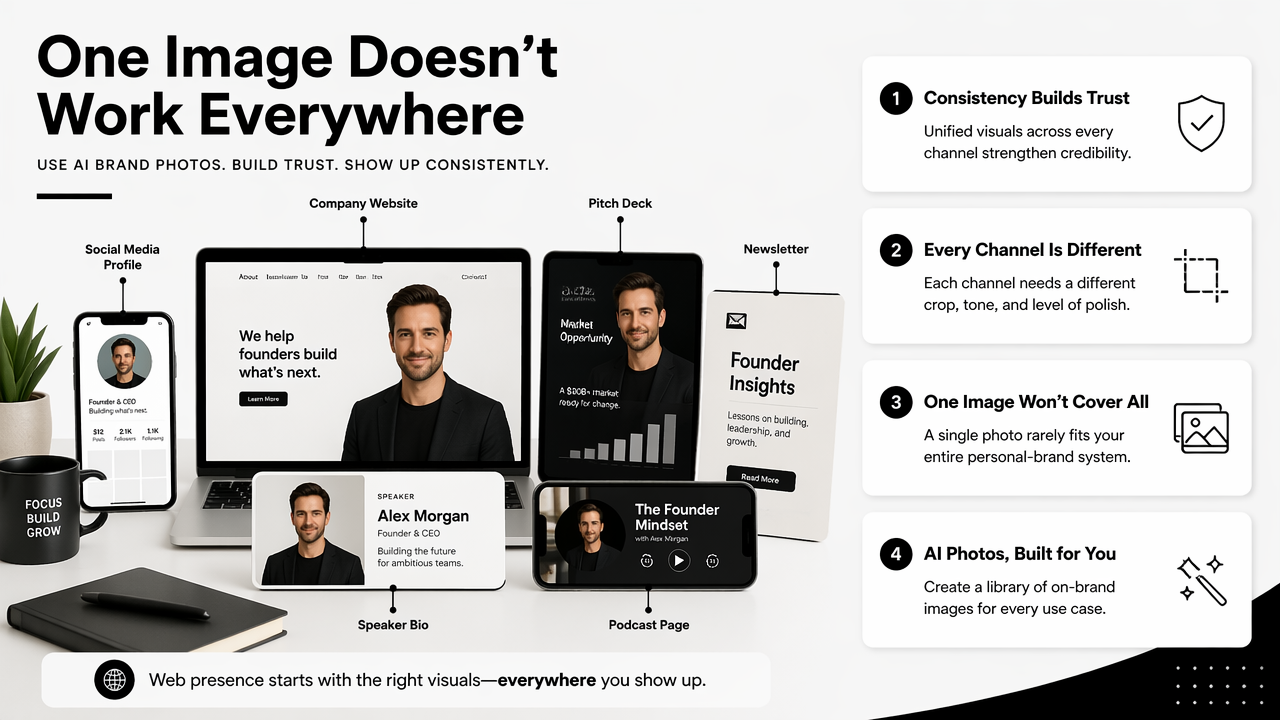
A website bio needs clarity and warmth. A speaker page needs authority. A LinkedIn image needs instant recognition at small size. A podcast cover or guest graphic may need more visual energy than a corporate profile photo.
Looktara can fit into this planning stage because the same founder image direction often extends into branded assets such as a LinkedIn post generator for fitness Shopify brands, launch visuals, and founder-led content. The photo becomes part of a larger content engine rather than a standalone file.
Best image types by business channel
| Channel | Best AI image style | Branding goal |
|---|---|---|
| LinkedIn profile | Clean headshot, neutral background, sharp eye contact | Build professional trust quickly. |
| Website about page | Relaxed portrait, branded workspace, natural expression | Show the person behind the company. |
| Speaker bio | Polished portrait, confident posture, high resolution | Signal authority for events and media. |
| Pitch deck | Founder portrait with clean background | Make the team slide feel credible. |
| Podcast guest page | Warm portrait with strong contrast | Help hosts promote the episode. |
| X, TikTok, YouTube | Bolder crops, expressive poses, brand colors | Improve recognition in fast feeds. |
A founder preparing investor or partner materials can pair portraits with visual storytelling assets, such as a pitch deck slide AI generator. That keeps the founder image, offer, and business narrative aligned.
A practical brand photo set
A useful entrepreneur image library should cover common marketing moments instead of chasing dozens of random variations.
- Primary headshot: LinkedIn, email signature, website author box.
- Friendly portrait: About page, newsletter welcome, coaching profile.
- Authority portrait: Speaker page, press kit, investor deck.
- Casual creator image: YouTube, TikTok, podcast promotion.
- Brand-color version: Social banners, quote graphics, launch posts.
Strong founder imagery feels familiar across platforms, but not identical. Repetition builds recognition; slight variation prevents fatigue.
How should founders create brand-safe AI portraits?
Founders should create brand-safe AI portraits by defining the use case, using accurate reference images, setting visual rules, reviewing for identity drift, and exporting platform-specific crops. A careful workflow protects trust while still saving time compared with repeated photo shoots.
- Define the business use case: LinkedIn, website, press kit, investor deck, or social campaign.
- Set the visual direction: industry, audience, wardrobe, background, color palette, and mood.
- Use accurate source photos: clear angles, current appearance, and natural expressions.
- Generate multiple controlled variations: avoid extreme styling that changes identity.
- Review for realism: check eyes, teeth, hands, hairline, skin texture, and brand fit.
- Export by channel: square, vertical, horizontal, and high-resolution versions.
The Looktara platform is most useful when founders already know the message each image must support. For example, a wellness ecommerce founder may need a credible headshot, a founder-story post, and a branded launch banner rather than one overly polished portrait.
Prompt structure for entrepreneur portraits
A reliable prompt should name the role, setting, tone, and output format. Vague prompts often create generic business portraits with little brand value.
- Role: founder, consultant, coach, creative director, agency owner, ecommerce operator.
- Audience: customers, investors, hiring candidates, media, community members.
- Setting: studio, office, workshop, gym, retail space, conference, home office.
- Mood: approachable, calm, premium, energetic, analytical, creative.
- Wardrobe: blazer, knit top, brand-color shirt, minimal accessories.
- Format: square profile crop, website hero, vertical social portrait, press-kit image.
A founder who uses AI portraits for social content can extend the same visual system into a quote post AI generator, which keeps thought-leadership graphics from looking disconnected from the profile image.
Quality checks before publishing
Synthetic portraits should pass a human review before reaching a public profile. Small defects can reduce credibility, especially in business categories where trust matters.
- Facial features match recent real-life appearance.
- Skin texture looks natural, not plastic.
- Hands, jewelry, collars, and glasses appear correct.
- Background does not imply a false workplace, award, or affiliation.
- Clothing fits the industry and price point.
- Crops work at thumbnail size and full-page size.
A 2022 survey on AI chatbot services in Multimedia Tools and Applications reviewed AI use in customer and public administration services, showing how AI systems increasingly shape user interactions across service contexts: study link. The same trust issue applies to founder images.
When should AI replace or support a photographer?
AI should support a photographer when a founder needs fast variations, channel-specific crops, or branded campaign visuals. It should replace a shoot only when the goal is simple professional imagery and the generated result remains authentic, accurate, and legally usable for the intended platform.
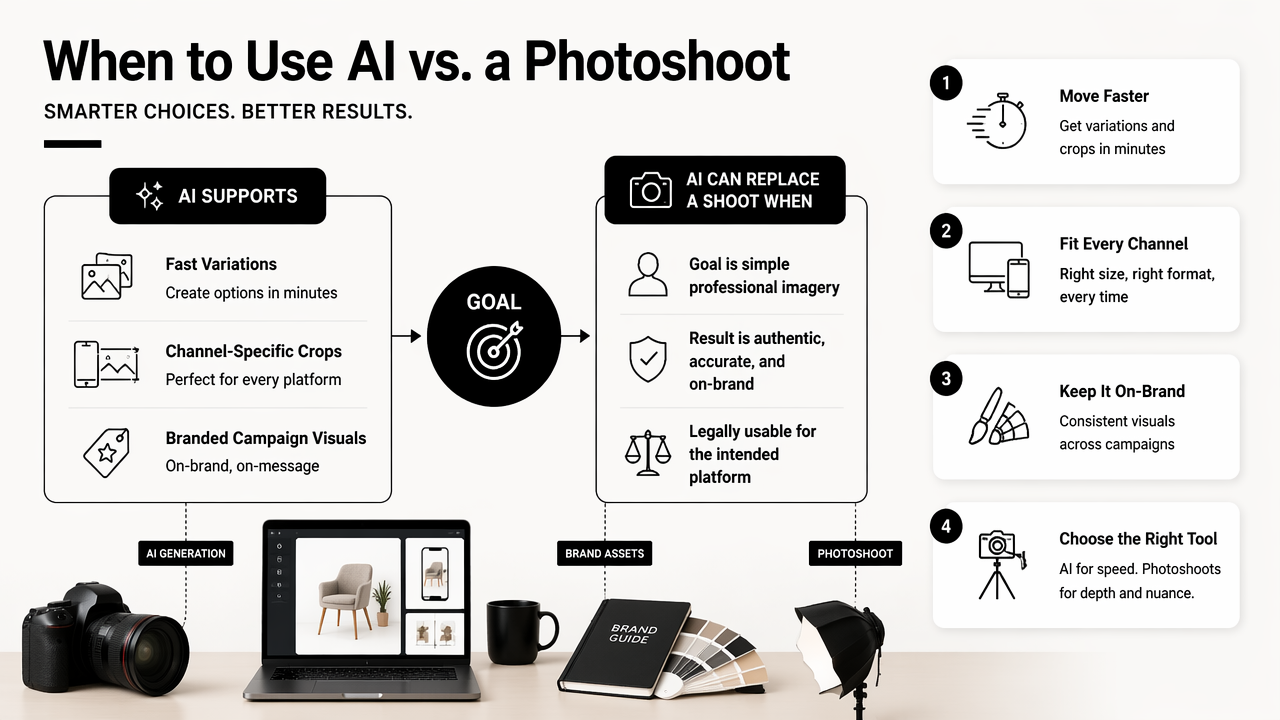
Traditional photography still has advantages for real locations, team culture, product handling, events, and high-stakes campaigns. AI works best for repeatable needs: updated headshots, social variants, newsletter graphics, and profile refreshes.
The strongest approach in 2026 is hybrid. A founder can use real photos for identity anchors and AI for controlled variations. This avoids the two extremes: expensive overproduction on one side and generic AI slop on the other.
AI portraits vs. traditional brand photography
| Criteria | AI photo generator | Traditional photographer | Hybrid workflow |
|---|---|---|---|
| Speed | Fast for many variations | Slower due to scheduling | Fast after an anchor shoot |
| Authentic setting | Can simulate scenes | Captures real spaces | Uses real assets plus AI variants |
| Cost pattern | Lower per variation | Higher per session | Balanced across campaigns |
| Creative control | Prompt-based | Directed on set | Strongest when brand rules are clear |
| Best use | Profiles, content, mockups | hero campaigns, team pages, events | founder brands with frequent publishing |
A founder building a media presence may also need show artwork, thumbnails, and campaign graphics. A related tool such as a podcast cover AI generator can support that broader identity system.
Ethical and legal guardrails
Founders should avoid AI portraits that misrepresent age, body type, credentials, location, partnerships, or results. A sharper image should not become a fictional identity.
Practical safeguards include:
- Use current likeness as the identity anchor.
- Avoid fake awards, uniforms, logos, or luxury settings that imply false status.
- Keep disclosure in mind for press and editorial contexts.
- Check commercial-use rights before publishing.
- Store final prompts and source files for brand records.
Research by Rolnick, Donti, Kaack, and coauthors in Tackling Climate Change with Machine Learning focused on machine learning and climate action. For image generation, the broader lesson is that AI choices carry operational tradeoffs, including compute use and governance.
FAQ: AI photos for entrepreneur branding
AI brand photos are moving toward more controlled, identity-safe, and channel-aware outputs in 2026 and 2027. Entrepreneurs should expect better consistency across image sets, stronger editing controls, and more scrutiny around authenticity as synthetic visuals become common in professional profiles.
Can AI-generated headshots be used on LinkedIn?
AI-generated headshots can be used on LinkedIn when the image accurately represents the person and looks professional at small size. The safest choice is a realistic crop with natural lighting, current likeness, and no misleading background. A dedicated resume headshot AI generator can help create career-focused options.
What makes an AI founder photo look authentic?
An AI founder photo looks authentic when facial features, expression, wardrobe, lighting, and context match the person's real business role. Overly smooth skin, impossible offices, strange hands, and exaggerated luxury cues often weaken trust. The best images feel like a polished version of a real brand moment.
How many personal-brand photos does an entrepreneur need?
Most entrepreneurs need five to eight strong images: a primary headshot, an about-page portrait, a speaker image, a casual social portrait, a horizontal website image, and a few campaign-specific variations. More images are useful only when each one serves a clear channel or business goal.
What should change in AI photo branding by 2027?
By 2027, AI photo tools should offer better likeness control, reusable brand kits, cleaner multi-platform exports, and clearer rights management. Entrepreneurs will likely judge tools less by novelty and more by whether the images remain consistent across LinkedIn, websites, press pages, and content campaigns.
How can founders start without overthinking the process?
The simplest start is one channel, one message, and one realistic portrait style. A founder can create a LinkedIn-ready image first, then expand into website and media assets after the visual direction feels right. For related brand graphics, looktara.com offers tools that support a broader founder-led content system.
Conclusion
The best AI photo workflow for entrepreneurs starts with strategy, not prompts. A strong personal-brand image system defines where each portrait will appear, what it should communicate, and how closely it must match real-life identity.
For an ai photo generator for entrepreneurs personal branding, the winning standard is simple: recognizable, credible, platform-ready, and consistent. Looktara can support that standard when founder photos need to connect with posts, decks, covers, and campaign visuals across the business. For a practical next step, choose one priority channel, create a primary headshot, build two supporting brand portraits, then visit looktara.com to expand the visual system into content assets that match the same founder identity.
Generated by EarlySEO.com