

TL;DR
Civil engineers should choose headshots that balance technical credibility with approachability: clean lighting, business-casual or site-ready styling, and neutral backgrounds work best. AI tools can create polished profile photos faster than a studio session, but privacy, realism, and role-specific styling still need careful review.
Civil engineering is a trust business, and a profile photo often becomes the first proof point before a résumé, proposal, or project biography is read. An AI headshot for civil engineers should show competence, safety awareness, and professional calm without looking like a generic stock image. AI headshot: a software-generated or software-enhanced portrait that turns uploaded photos into polished professional images for career, business, and public-profile use. For engineers updating LinkedIn, bid documents, team pages, or conference bios, Looktara can help create role-aware images that look clean, current, and credible.
Table of Contents
What is an AI headshot for civil engineers?
An AI headshot for civil engineers is a professional portrait generated from existing photos and styled for engineering contexts such as LinkedIn, résumés, project proposals, consulting profiles, and company directories. The strongest versions look realistic, match the engineer's field, and avoid theatrical construction clichés.
LinkedIn is widely used for professional networking and career development, so the headshot there has a different job than a casual social media image. It needs to make a civil engineer look ready for client meetings, site coordination, technical reviews, and hiring conversations.
Key insight: The best engineering headshot does not scream "construction." It quietly signals judgment, accuracy, and responsibility.
AI tools matter because traditional studio photography can be slow, location-bound, and hard to repeat when a team grows. A generated portrait can support fast profile updates, especially for remote engineers, consultants, and small firms that need consistent team imagery.
Core terms for engineering profile photos
Civil engineering headshot: a professional portrait built for people who plan, design, inspect, manage, or consult on infrastructure and built-environment projects.
Site-ready styling: clothing and visual cues that feel appropriate near a project setting, such as a collared shirt, blazer, safety vest, or hard hat when the context calls for it.
Business-casual styling: a polished but approachable look, usually a shirt, blouse, blazer, or knit layer, suited for LinkedIn, résumés, and client-facing profiles.
Neutral background: a simple office, studio, light gray, muted blue, or soft outdoor backdrop that keeps attention on the face rather than the setting.
AI headshots versus stock engineer images
| Option | Best use | Main advantage | Main limit |
|---|---|---|---|
| AI headshot | LinkedIn, résumé, proposal bio | Personalized and fast | Requires quality source photos |
| Studio headshot | Executive pages, press kits | High control over lighting | Higher cost and scheduling time |
| Stock engineer image | Blog graphics, ads, placeholders | Easy to license | Not an authentic personal portrait |
| Casual selfie | Internal chat, informal use | Quick and personal | Often lacks career polish |
Search results often mix personal headshot tools with large image libraries. Adobe Stock-style libraries can show hundreds of thousands of civil engineer visuals, but stock photos cannot replace an identifiable professional portrait for a licensed engineer, project manager, or consultant.
How should civil engineers style a professional headshot?
Civil engineers should style a professional headshot around the intended trust signal: business-casual for networking, site-ready for field credibility, and executive-neutral for proposals or leadership pages. Clothing, background, facial expression, and image crop should work together rather than compete.
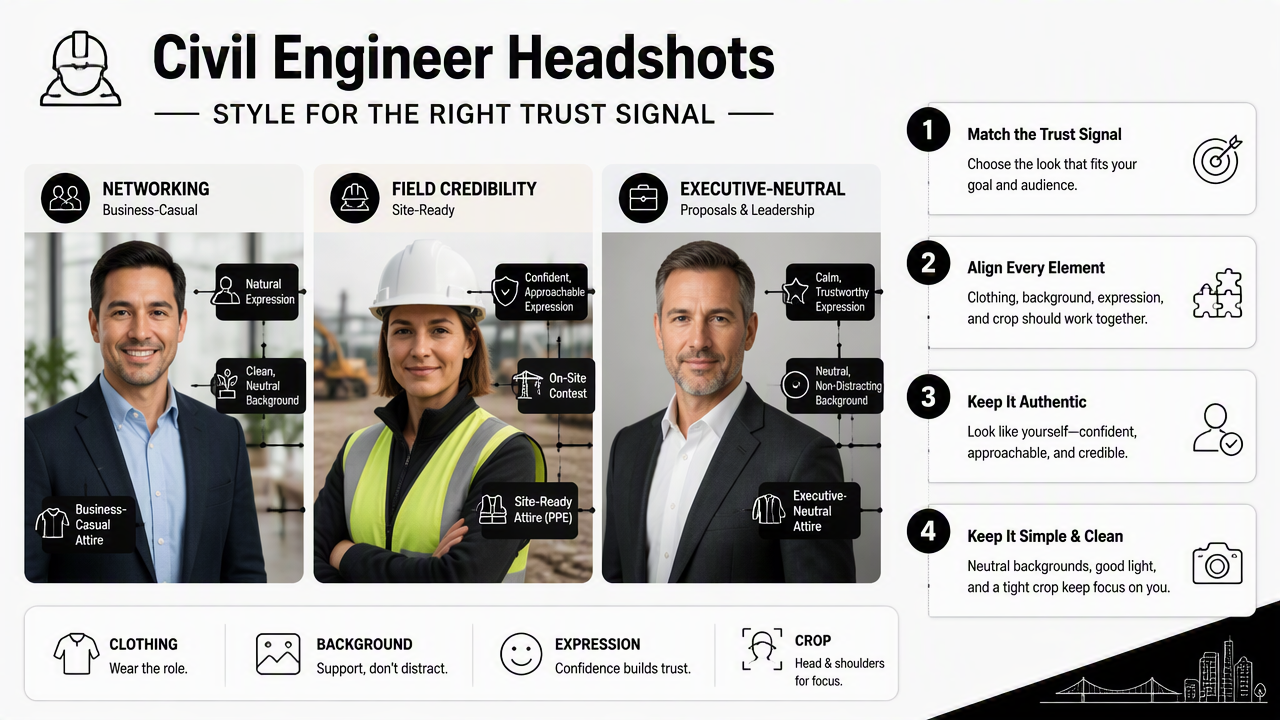
The safest default is a clean, well-fitted business-casual look. A navy blazer, collared shirt, simple blouse, or technical jacket usually reads more credible than a logo-heavy vest or dramatic hard-hat pose.
For field-focused roles, site context can help. A safety vest or hard hat makes sense for construction managers, resident engineers, inspectors, and transportation engineers when the image is used in project-facing materials.
Key insight: A civil engineer's profile photo should match the setting where trust is earned, not just the setting where the photo looks impressive.
Style choices by engineering role
| Civil engineering role | Best styling | Best background | Avoid |
|---|---|---|---|
| Structural engineer | Blazer or collared shirt | Office, neutral studio | Overbuilt skyscraper clichés |
| Transportation engineer | Business-casual or site-ready | Roadway, planning room, neutral | Distracting traffic scenes |
| Construction manager | Vest over neat shirt | Soft jobsite context | Dirty PPE or unsafe poses |
| Geotechnical engineer | Field jacket or collared shirt | Outdoor neutral, lab, office | Muddy or overly rugged looks |
| Civil consultant | Blazer, clean shirt | Studio, office, city backdrop | Casual vacation-style photos |
For civil engineers who also maintain wellness, coaching, or creator profiles, a separate professional-image set can help keep audiences distinct. A profile aimed at broader résumé visibility may fit a polished generator page such as LinkedIn and résumé headshot options, while engineering firm pages usually need a more restrained look.
A simple headshot preparation checklist
- Select 8 to 12 clear source photos with natural facial angles.
- Include recent images that match current hair, glasses, and facial hair.
- Choose professional clothing that already fits the target role.
- Avoid sunglasses, heavy filters, unusual crops, and group shots.
- Pick outputs with natural skin texture and realistic lighting.
- Compare the final image against LinkedIn, résumé, and proposal use cases.
- Reject any result that changes facial structure, age, or identity.
Small details affect credibility. Crooked collars, overly white teeth, plastic-looking skin, or a background that resembles a fantasy construction site can weaken an otherwise strong professional image.
Where should civil engineers use AI-generated headshots?
Civil engineers should use AI-generated headshots on professional channels where identity, credibility, and consistency matter: LinkedIn, résumé headers, company directories, proposal bios, conference pages, newsletters, and portfolio websites. The same image should not automatically appear everywhere, because each channel has a different audience.
LinkedIn rewards recognizability and approachability. A tight crop, direct eye contact, and simple background help recruiters, clients, and peers connect the profile photo with the engineer's name and experience.
Proposal bios need a slightly different tone. The photo should feel credible beside project experience, licenses, certifications, and delivery responsibilities, not overly casual or influencer-like.
Company pages benefit from consistency. When multiple engineers appear in a team grid, similar lighting, crop, and background can make a small firm look more organized without forcing every person into identical poses.
Best image style by placement
| Placement | Recommended look | Why it works |
|---|---|---|
| LinkedIn profile | Business-casual, direct crop | Supports networking and hiring visibility |
| Résumé or CV | Neutral studio, minimal styling | Keeps focus on qualifications |
| Proposal bio | Senior, calm, client-ready | Builds confidence in delivery responsibility |
| Company team page | Consistent background and crop | Makes the firm look organized |
| Newsletter byline | Warm expression, clean lighting | Helps readers recognize the author |
| Speaking profile | Executive-neutral or conference-ready | Matches public expert positioning |
Civil engineers publishing technical commentary, safety updates, or firm news may also need byline imagery. A practical next step for content-driven professionals is a polished newsletter and résumé headshot workflow, especially when a single image set needs to support multiple professional channels.
Profile-photo mistakes that reduce credibility
- Using a hard hat in contexts where no field role is being presented.
- Choosing a dramatic infrastructure background that distracts from the face.
- Cropping too far away, which makes the image weak in search and mobile views.
- Selecting AI outputs with distorted hands, badges, logos, or PPE details.
- Mixing casual dating-app style photos with professional engineering materials.
The issue is not that creative images are always wrong. The issue is mismatch. A principal engineer bidding on a public infrastructure project needs a different visual signal than a creator explaining bridge design on social media.
How does Looktara handle civil engineering headshots?
Looktara helps civil engineers create polished headshots that can be matched to professional use cases such as LinkedIn, résumés, newsletters, and public profiles. The strongest workflow is to start with realistic source photos, choose role-appropriate styling, and keep the final selection grounded in engineering credibility.
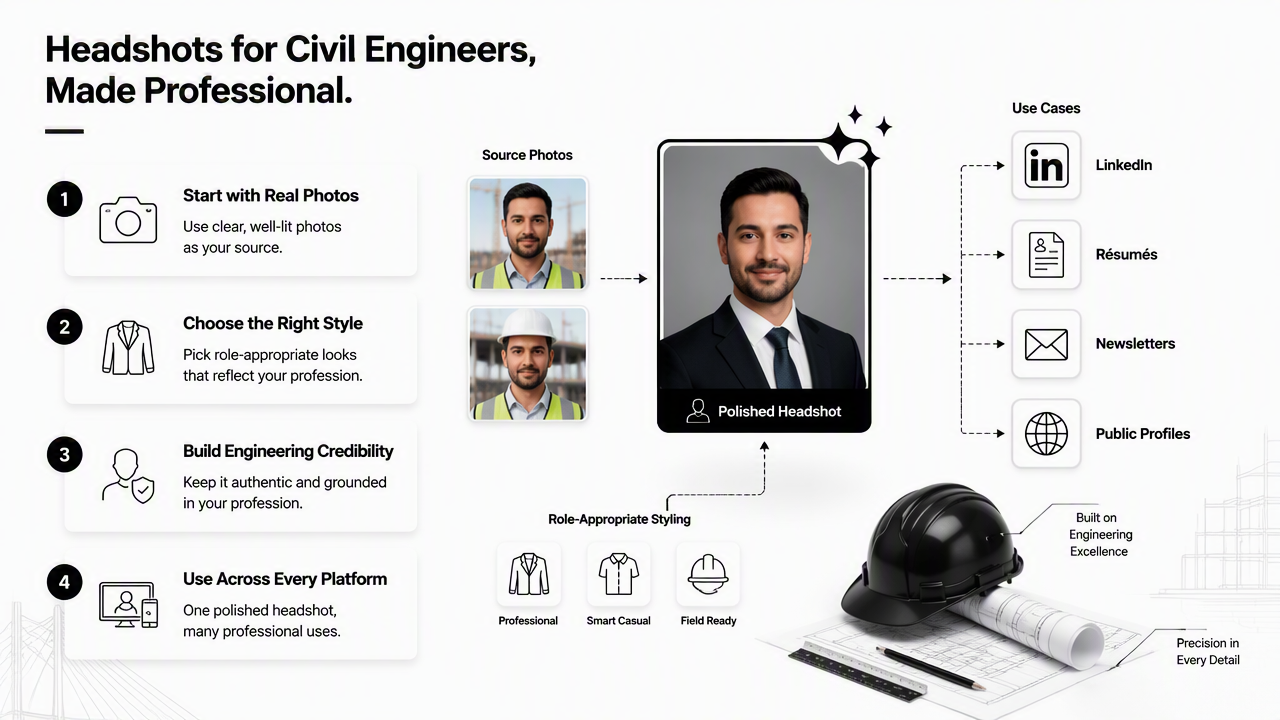
The Looktara platform fits professionals who need a practical alternative to a traditional studio session. A civil engineer can prepare a set for recruiter visibility, client-facing materials, or a refreshed company page without building a full photoshoot around one portrait.
Looktara is especially useful when the goal is not glamour but consistency. For engineers, that means clean lighting, realistic facial detail, neutral or workplace-adjacent backgrounds, and clothing that feels appropriate for technical work.
Civil engineer headshot decision guide
| Need | Best choice | Reason |
|---|---|---|
| Fast LinkedIn refresh | AI-generated headshot | Quick update with professional polish |
| Firm-wide team page | AI headshot set | Consistent look across distributed staff |
| Award announcement | Studio or premium AI output | Higher visibility requires extra review |
| Government proposal bio | Conservative AI or studio portrait | Formal procurement materials need restraint |
| Personal brand content | Multiple AI styles | Different channels need different tones |
A practical approach is to generate several options, then choose only the images that could plausibly appear in a real firm directory. The best selection usually looks understated, not flashy.
Privacy and fairness checks before publishing
Generative AI headshots involve personal images, so privacy and representation deserve attention. A 2024 IEEE Access survey by Abenezer Golda, Kidus Abebe Mekonen, and Amit Pandey examined privacy and security concerns in generative AI, which makes image handling a valid selection factor for any professional tool.
Fairness also matters in professional imagery. Inga Ulnicane's 2024 article on intersectionality in artificial intelligence frames concerns around AI systems and social identity, a useful reminder that generated headshots should preserve age, skin tone, hair texture, disability cues, and cultural presentation accurately.
Key insight: A usable AI headshot is not only attractive. It must protect identity, preserve likeness, and represent the professional fairly.
Before publishing, the engineer or firm should review whether the image changes visible identity markers, invents licenses or logos, or creates unrealistic safety gear. If any of those issues appear, that output should be discarded.
What should civil engineers expect from AI headshots in 2027?
Civil engineers should expect AI headshots in 2027 to become more role-specific, more privacy-conscious, and more connected to professional-brand systems. The biggest change will likely be better control over context: office, site, proposal, conference, or creator profile.
Headshot tools are already moving beyond one generic corporate look. Engineering professionals will likely see more controlled style presets for infrastructure, construction management, architecture-engineering firms, public agencies, and consulting teams.
A second shift will be consistency across surfaces. One professional may need a square LinkedIn image, a horizontal website crop, a newsletter byline, and a formal proposal portrait. The value will come from one recognizable identity adapted to several formats.
For career professionals who want a clean place to start, looktara.com offers a direct path to creating polished profile imagery without arranging a studio day.
Future-ready headshot standards
- Keep the face recognizable across all formats.
- Use realistic lighting rather than synthetic gloss.
- Choose backgrounds that support the role, not the fantasy of the role.
- Maintain separate styles for LinkedIn, proposals, dating apps, and creator profiles.
- Revisit the image after major career changes, license updates, or role shifts.
Professional photos will keep becoming easier to generate. The hard part will remain editorial judgment: selecting the image that matches the engineer's actual work and reputation.
FAQ
What makes a civil engineering headshot different from a corporate headshot?
A civil engineering headshot needs to communicate technical credibility, not just office polish. Business-casual styling works for LinkedIn and résumés, while site-ready styling can fit construction management, inspection, or field engineering roles. The best image looks competent, safe, and approachable.
Should a civil engineer wear a hard hat in an AI headshot?
A hard hat should appear only when it matches the role and usage. It can help for construction managers, inspectors, and field engineers, but it may look forced for design consultants, structural analysts, or executives using the image for proposals.
Can an AI headshot be used on a proposal bio?
An AI headshot can be used on a proposal bio if it looks realistic, preserves identity, and fits the formality of the bid. Conservative backgrounds, natural lighting, and accurate facial details are better than dramatic jobsite scenes or stylized portraits.
How many headshot styles should a civil engineer create?
Most civil engineers benefit from two or three styles: a LinkedIn-ready portrait, a formal proposal or company-page image, and a warmer byline or personal-brand version. Separate styles help prevent one photo from doing too many jobs.
When should a professional headshot be updated?
A professional headshot should be updated after a role change, major appearance change, new license, promotion, firm rebrand, or shift into consulting. For active job seekers and business owners, a yearly review keeps profile imagery current.
Conclusion
A strong AI headshot for civil engineers should look believable, technically credible, and suited to the channel where it appears. The practical next step is simple: gather recent source photos, choose business-casual or site-ready styling, reject unrealistic outputs, and publish the final image consistently across priority profiles. For engineers ready to refresh professional imagery, visit looktara.com and create a headshot set that supports LinkedIn visibility, proposal trust, and a cleaner public brand.
Generated by EarlySEO.com